
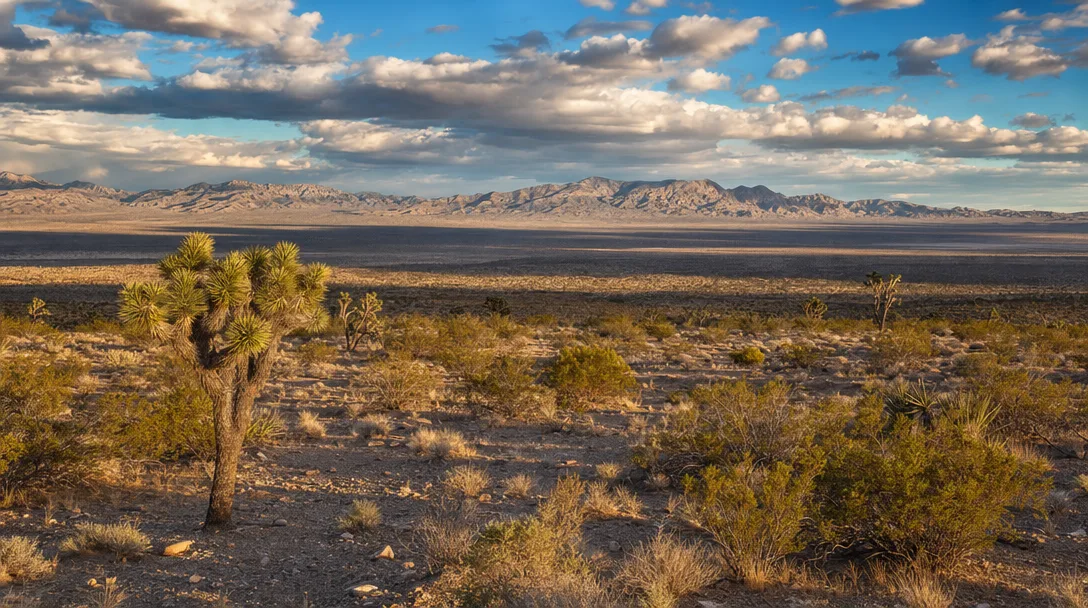
Las Vegas is not just near the desert. It is in the desert. The city sits in the Mojave Desert, one of the four major North American deserts and the smallest but most biodiverse. Understanding the desert landscape that surrounds the city helps buyers appreciate why homes look the way they do, why water costs what it costs, and why the views are so remarkable.\n\nThe Mojave Desert\n\nThe Mojave Desert covers approximately 48,000 square miles across Nevada, California, Utah, and Arizona. It is defined by its elevation range, its unique plant life, and its extremes of temperature. The Mojave is the driest desert in North America, receiving less than six inches of precipitation annually in most areas. It is also home to the Joshua tree, which grows almost exclusively in the Mojave and serves as a defining symbol of this particular desert ecosystem.\n\nHow the Desert Shapes Homeownership\n\nLiving in the desert affects nearly every aspect of homeownership. Landscaping in Las Vegas emphasizes drought-tolerant plants, rock gardens, and efficient irrigation systems. Grass lawns are uncommon and expensive to maintain. Pool ownership is popular as a way to cool off during summer months but requires ongoing chemical and water management. Solar panels are increasingly common, taking advantage of more than 300 sunny days per year to offset electricity costs.\n\nConstruction and building materials also reflect the desert environment. Homes use energy-efficient windows, reflective roofing materials, and well-insulated walls. HVAC systems are designed for the cooling load of 110-degree summers rather than the minimal heating needs of mild winters. Understanding these factors helps buyers evaluate a home's operating costs accurately.\n\nDesert Views That Add Value\n\nOne of the most valued features of Las Vegas real estate is a desert view. Homes that face the Spring Mountains, Red Rock Canyon, or the desert landscape beyond the valley command premium prices. The ability to watch the sunset paint the mountains gold and red is a daily amenity that homeowners in few other major cities can enjoy. For buyers, paying attention to lot orientation, window placement, and whether views are protected from future development is an important part of the home search.\n\nThe desert surrounding Las Vegas is not an empty landscape. It is a vibrant, living ecosystem that shapes the character of the city and the homes within it. Buyers who understand the desert are better prepared to make smart real estate decisions.
The Desert Surrounding Las Vegas

Reviewed by
Lisa C Hamilton, REALTOR®
Lisa C Hamilton is a Las Vegas Valley REALTOR® affiliated with THE Brokerage, A Real Estate Firm®, helping buyers, sellers, investors, and relocating clients across Clark County and Greater Las Vegas with local market knowledge, property research, and direct personal representation. Nevada License S.168195.
Ready to Talk Real Estate?
Ask Lisa, get a free Property DNA report, or find out what your Nevada home is worth.
Property DNA reports are free, available nationwide, with no limit on how many you can order. Enter your contact information once and request reports for multiple property addresses. Reports are delivered by email, usually within one hour during normal business hours. A Property DNA report is not a title search, title commitment, title insurance policy, appraisal, inspection, survey, or legal or tax advice.