

THE COMPLETE LAS VEGAS REAL ESTATE INVESTOR BUYER'S GUIDE
Before You Buy an “Investment Property,” Figure Out What Investment You're Actually Trying to Make
For first-time real-estate investors, experienced rental-property owners, fix-and-flip investors, BRRRR investors, people building portfolios, and people who are simply beginning to wonder whether buying an investment property in Las Vegas makes sense. Written by Lisa C Hamilton for Las Vegas, Henderson, North Las Vegas and all of Clark County.
Investor Market Snapshot last updated: September 22, 2026
FIRST: WHAT KIND OF INVESTOR ARE YOU TRYING TO BE?
“I want to buy an investment property” sounds specific.
It isn't.
Are you buying something to hold for ten years and rent?
Are you primarily trying to create monthly cash flow?
Are you willing to accept less immediate cash flow because you believe the property has stronger long-term potential?
Are you buying something ugly, improving it and reselling it?
Are you planning to renovate, rent, refinance and repeat?
Are you considering a small multifamily property?
Are you buying the first property in what you hope eventually becomes a portfolio?
Those are very different investments.
The property that makes a fantastic flip may make a terrible long-term rental. The property that produces dependable rental income may not have enough spread between acquisition cost, renovation and resale value to make sense as a flip.
And a beautiful house you personally love may be a terrible investment because the numbers simply don't work.
That is the first mental shift.
When you're buying your own home, emotion gets a vote.
When you're buying an investment:
THE MATH GETS A MUCH BIGGER VOTE.
IF THIS IS YOUR FIRST INVESTMENT PROPERTY, START HERE
Your first investment should not be designed around proving you're a real-estate genius.
It should be designed around understanding what you're actually buying.
One of the easiest beginner mistakes is evaluating only two numbers:
Purchase price.
and:
Rent.
You see a $400,000 house that might rent for $2,500 per month and think:
Great. $2,500 coming in every month.
Except $2,500 isn't profit.
There may be a mortgage.
Property taxes
Insurance
HOA dues
Repairs
Maintenance
Vacancy
Property management
Capital expenditures
Landscaping
Pool service
Utilities the landlord pays
Leasing or turnover expenses
Accounting
And the air conditioner that waits until July to remind you that you are the person who owns it.
Rental-property investing begins when you stop calculating:
Rent minus mortgage
and begin calculating:
INCOME MINUS ALL REALISTIC EXPENSES.
A property can collect a healthy-looking rent check every month and still produce a disappointing return once the actual cost of owning it is included.
That's why this guide needs more than a mortgage calculator.
We're going to build the investment out from the numbers that actually matter.
THE INVESTOR CALCULATOR CENTER
This should become one of the most useful interactive areas on Lisa's entire website.
Do not put one generic mortgage calculator here and rename it “Investment Calculator.”
Different investment strategies need different math.
Build separate educational calculators for:
The calculators on this page were built with established investor methods in mind, the same categories and methodology investors commonly analyze with tools such as BiggerPockets' rental, flip and BRRRR calculators and reputable financial calculators.
RENTAL PROPERTY / BUY-AND-HOLD CALCULATOR
A rental calculator should answer a much more useful question than:
What is my mortgage payment?
It should help answer:
WHAT MIGHT THIS PROPERTY ACTUALLY PRODUCE?
Rental Property Calculator
PRELIMINARY ESTIMATE — NOT A QUOTE
Acquisition
Financing
Income
Expenses
Long term
ESTIMATED RESULTS UNDER YOUR ASSUMPTIONS
Monthly cash flow
$0
Annual cash flow
$0
Net operating income
$0
Cap rate
0.00%
Cash-on-cash return
0.00%
Total cash invested
$0
Mortgage payment (P&I)
$0
Monthly operating expenses
$0
Projected appreciation is never presented as guaranteed. Estimated rent is never presented as guaranteed. Both are assumptions you entered; change them and watch what happens. That is where the learning happens.
WHAT IS CAP RATE?
Cap rate gives investors one way to compare the operating performance of properties without allowing the financing structure to dominate the comparison.
In simplified form:
CAP RATE = NET OPERATING INCOME ÷ PROPERTY VALUE OR PURCHASE PRICE
If a $400,000 property produces $24,000 in annual net operating income, that would equal a 6% cap rate.
But the important phrase is:
Net operating income.
If somebody calculates cap rate using gross rent and conveniently forgets vacancy, maintenance, insurance, property taxes, management and other operating expenses, the resulting cap rate isn't particularly useful.
Mortgage payments generally aren't included in NOI because cap rate is intended to evaluate the property before financing.
That makes it useful for comparing two properties even if one investor intends to pay cash and another intends to finance.
Cap rate is a tool.
It is not a complete investment decision.
WHAT IS CASH-ON-CASH RETURN?
Cash-on-cash return asks a different question:
WHAT RETURN AM I GETTING ON THE CASH I ACTUALLY PUT INTO THIS DEAL?
Suppose you invest $100,000 between your down payment, closing costs and initial property costs.
If the property produces $8,000 in annual pre-tax cash flow under your assumptions, that's approximately an 8% cash-on-cash return.
This becomes particularly useful when comparing different financing structures.
A property can have the same cap rate regardless of whether you finance it.
Cash-on-cash return changes because financing changes how much of your own money is invested and how much debt service the property carries.
Neither metric tells the whole story.
Together, they tell you considerably more than:
It rents for $2,500.
USE PROPERTY DNA WHEN YOU'RE ANALYZING RENT
Property DNA can be particularly useful for investors because reports may include rental-value information where available, along with other property intelligence.
That can give you another data point when you're trying to estimate what a property might rent for.
But do not buy a property because one automated rent estimate says:
$2,800 per month.
Look at actual market evidence too.
What are similar properties currently asking?
What have comparable properties leased for where reliable data is available?
How does the condition compare?
Bedrooms?
Bathrooms?
Garage?
Pool?
Lot?
Community?
HOA restrictions?
Location?
A rental estimate is useful.
A signed lease at that amount is something entirely different.
Use Property DNA as one piece of the underwriting.
Property DNA is free through Lisa and can be ordered on multiple properties.
Reports are usually returned within approximately one hour during normal business hours, with current typical turnaround around 40 minutes. Turnaround can vary based on data availability, volume, evenings, weekends and holidays.
Property DNA information comes from third-party, public-record and other available data sources believed reliable but is not guaranteed. It is not an appraisal, inspection, title report, title insurance policy, survey, legal opinion, lending decision or guarantee of rent, value or investment performance.
DON'T USE “AVERAGE LAS VEGAS RENT” TO UNDERWRITE ONE HOUSE
Broad rental statistics are useful for understanding a market.
They're terrible substitutes for property-specific analysis.
Las Vegas contains apartments, condos, townhomes, luxury houses, small single-family homes and properties with dramatically different features.
A metro-wide average mixes them together.
If you're considering a three-bedroom single-family home in Henderson, the useful question isn't:
What's the average rent in Las Vegas?
It is:
WHAT ARE PROPERTIES THAT ACTUALLY COMPETE WITH THIS ONE RENTING FOR?
That is a much better number to put into the calculator.
FIX-AND-FLIP CALCULATOR
A flip calculator should make it difficult to accidentally lie to yourself.
Fix & Flip Calculator
PRELIMINARY ESTIMATE — NOT A QUOTE
ESTIMATED RESULTS UNDER YOUR ASSUMPTIONS
Total acquisition cost
$0
Financing expense
$0
Rehab budget
$0
Holding costs
$0
Total project cost
$0
Estimated gross spread
$0
Estimated project profit
$0
Estimated ROI
0.00%
This model uses an interest-only approximation for financing during the hold. Renovation costs, timelines and resale prices are assumptions you entered, not guarantees. A deal that works only if absolutely nothing goes wrong is a deal with very little margin.
THE NUMBER THAT DESTROYS BAD FLIPS ISN'T USUALLY THE RESALE PRICE
Imagine buying a property for $300,000 and believing it will be worth $425,000 when finished.
The inexperienced version of the calculation is:
$425,000 - $300,000 = $125,000.
Fantastic.
Except you haven't made $125,000.
You haven't paid acquisition costs.
Financing
Points
Interest
Renovation
Permits
Insurance
Utilities
Property taxes
HOA
Holding costs
Resale expenses
Unexpected repairs
Or the additional two months that appear when cabinets don't arrive when somebody promised they would.
And your $425,000 ARV was an estimate made before you even owned the house.
That is why a flip should be modeled with room for reality.
A deal that works only if absolutely nothing goes wrong is a deal with very little margin for being a real house.
WHAT DO HOUSE FLIPPERS ACTUALLY MAKE?
Use current sourced market data rather than inventing a “typical first flip.”
ATTOM, Q1 2026 national flipping data
~$66,000
typical gross profit per flip
ATTOM, Q1 2026 national flipping data
~25.4%
typical gross return on the original purchase price
The word gross matters enormously.
That number represents the spread between acquisition and resale before rehab and many other investor expenses.
It does not mean the typical flipper deposited $66,000 of actual profit.
ATTOM's broader flipping research has noted that experienced flippers estimate rehab and related project costs can consume roughly 20% to 33% of after-repair value in some projects.
So when somebody says:
“That flipper bought it for $300,000 and sold it for $400,000. They made a hundred grand!”
Maybe.
But probably don't calculate their profit from two numbers on Zillow.
You don't know what happened between those transactions.
THERE IS NO RELIABLE “AVERAGE FIRST FLIP PROFIT”
Do not publish a claim that the average beginner makes $10,000, $20,000 or any other arbitrary amount on their first flip.
There isn't credible national data establishing a universal first-time-flipper result like that.
A first flip could make $80,000.
It could make $8,000.
It could break even.
It could lose money.
The more useful lesson is:
UNDERWRITE YOUR FIRST DEAL AS THOUGH YOU DO NOT YET KNOW WHAT YOU DON'T KNOW.
Build contingency into the rehab.
Build additional time into the holding period.
Get actual bids.
Have appropriate inspections.
Do not base renovation costs on television.
And if your projected profit requires you to personally perform 600 hours of labor for free, remember that your time still has value even if your spreadsheet refuses to acknowledge it.
WHAT IS AFTER-REPAIR VALUE?
After-repair value—usually called ARV—is the estimated market value of the property after the planned renovation is completed.
ARV is one of the most important numbers in a flip.
It's also one of the easiest numbers to inflate when somebody desperately wants a deal to work.
ARV should not mean:
The nicest remodeled house within three miles sold for $600,000, so mine will too.
The comparison needs to make sense.
Location
Property type
Size
Lot
Condition after renovation
Features
Buyer appeal
And current market conditions.
If your projected profit disappears when the ARV changes from $550,000 to $520,000, that $30,000 assumption deserves serious attention before you buy.
ARV / MAXIMUM PURCHASE PRICE CALCULATOR
PRELIMINARY ESTIMATE — NOT A QUOTE
ESTIMATED MAXIMUM ACQUISITION PRICE
$0
The highest purchase price your entered assumptions support.
70%-Rule Screening Heuristic
$0
70% of estimated after-repair value, minus estimated renovation. A common investor screen.
RULES OF THUMB SCREEN DEALS. THEY DO NOT UNDERWRITE THEM.
A percentage formula does not know whether the house needs a $25,000 HVAC and roof package. It doesn't know your financing. It doesn't know your resale costs. It doesn't know the neighborhood. It doesn't know whether your renovation takes three months or nine. Use a shortcut to identify something worth investigating. Then do the real math.
REHAB BUDGET CALCULATOR
For a first-time flipper, this may be one of the most useful calculators on the entire site.
Don't ask:
How much will renovation cost?
and provide one blank box.
Break the project down.
Rehab Estimator
PRELIMINARY ESTIMATE — NOT A QUOTE
TOTAL PROJECTED REHAB
$0
This is a planning tool. It is not a contractor bid. Get actual bids from licensed contractors before you commit to a number.
YOUR CONTRACTOR'S NUMBER MATTERS MORE THAN YOUR PINTEREST BOARD
A distressed property can look deceptively simple during a ten-minute walkthrough.
Paint.
Floors.
Kitchen.
Done.
Then somebody who actually knows construction starts looking.
Electrical
Plumbing
Roof
HVAC
Drainage
Pool equipment
Windows
Permits
Unpermitted additions
Things behind walls.
Investment-property renovation isn't simply choosing attractive countertops.
Before purchasing a significant rehab, understand which professionals need to evaluate the property and what access you can obtain during due diligence.
A smart investor doesn't need to know how to personally repair everything.
They need to know when they're looking at something that requires a person who does.
BRRRR: BUY, REHAB, RENT, REFINANCE, REPEAT
BRRRR combines value-add investing with long-term ownership.
The investor buys a property, renovates it, rents it, refinances based on the improved property and applicable lender requirements, then potentially uses returned capital toward another investment.
It sounds beautifully circular when written as five words.
The actual strategy has several places where the numbers can change.
The renovation can cost more.
The rent can come in lower.
The appraisal can come in lower.
The refinance rate can be higher.
The lender may lend less than projected.
The property may take longer to stabilize.
That's why the BRRRR calculator needs to model the entire cycle rather than simply showing purchase price and ARV.
BRRRR Calculator
PRELIMINARY ESTIMATE — NOT A QUOTE
ESTIMATED BRRRR CYCLE UNDER YOUR ASSUMPTIONS
Cash invested before refinance
$0
Est. cash returned at refinance
$0
Est. cash remaining in the deal
$0
Est. post-refinance cash flow
$0
Future value and refinance terms are estimates. Never present them as guaranteed. The future refinance depends on the future appraised value, lender guidelines, loan-to-value limits, property eligibility, borrower qualification, treatment of rental income, seasoning requirements where applicable, market interest rates and other underwriting requirements.
THE REFINANCE IS NOT MAGIC
This deserves its own explanation because BRRRR content online can sometimes make the refinance sound automatic.
It isn't.
You do not necessarily get all of your cash back because you renovated the property.
The future refinance depends on the future appraised value, lender guidelines, loan-to-value limits, property eligibility, borrower qualification, treatment of rental income, seasoning requirements where applicable, market interest rates and other underwriting requirements.
If you expected a $400,000 appraisal and get $365,000, the entire capital-recycling plan can change.
If you expected one interest rate and rates are materially higher when you're ready to refinance, post-refinance cash flow can change.
The second R is not a victory lap.
It's another transaction that needs to work.
BUILD A RENTAL CASH-FLOW STRESS TEST
The normal rental calculator tells an investor what happens under their assumptions.
The stress test should ask:
WHAT HAPPENS WHEN THE PROPERTY HAS A BAD YEAR?
Show three scenarios.
Rental Stress Test
PRELIMINARY ESTIMATE — NOT A QUOTE
SCENARIO 1: EXPECTED YEAR
Normal rent. Expected vacancy. Normal maintenance.
$0
estimated annual cash flow
SCENARIO 2: ROUGH YEAR
One month vacant. Higher maintenance. An unexpected repair.
$0
estimated annual cash flow
SCENARIO 3: REALLY ROUGH YEAR
Two months vacant. A significant HVAC, plumbing or other major expense.
$0
estimated annual cash flow
MARGIN MATTERS.
A property producing $500 per month under ordinary assumptions has more room to absorb a bad year than one producing $40.
The goal isn't to convince people every terrible thing will happen. It's to understand whether one ordinary ownership problem completely destroys the economics.
TIME IS AN INVESTMENT EXPENSE
Build a dedicated holding-cost calculator for flips and value-add properties.
The investor enters monthly interest, insurance, taxes, HOA, utilities and other recurring holding expenses.
Holding-Cost Calculator
PRELIMINARY ESTIMATE — NOT A QUOTE
WHAT DELAY COSTS
Cost per month
$0
Total holding cost at your timeline
$0
Cost of a three-month delay
$0
ATTOM reported that homes flipped during 2025 took an average of approximately 163 days from purchase to resale nationally—more than five months. That doesn't mean your Las Vegas flip will take exactly 163 days. It means a beginner's spreadsheet assuming they buy January 1, remodel in three weeks and have their resale proceeds by Valentine's Day deserves another scenario. A profitable project should ideally have enough margin that a delay is frustrating rather than catastrophic.
FINANCING AN INVESTMENT PROPERTY IS DIFFERENT FROM FINANCING YOUR HOME
This is another place where first-time investors can be surprised.
Someone may have bought their primary residence using a low-down-payment loan and assume the next property works the same way.
Investment-property financing generally receives different risk treatment.
For eligible conventional one-unit investment-property purchases, current Freddie Mac published maximum LTV guidelines can allow financing up to 85% in qualifying scenarios, which mathematically corresponds to 15% down. Other property types and scenarios can require more equity, and individual lender requirements can be more conservative.
That does not mean:
Every investor gets to buy a rental with 15% down.
Credit.
Reserves.
Property type.
Number of units.
Borrower profile.
Loan amount.
Program.
And lender overlays can all affect what is actually available.
The financing conversation needs to happen before the investment spreadsheet assumes a loan that the buyer cannot actually obtain.
RESERVES MATTER
Lenders financing investment property may want to see that the borrower has money left after closing.
That makes sense.
The tenant can leave.
A repair can happen.
A property can sit vacant.
Fannie Mae's current guidance includes reserve requirements for applicable investment-property transactions and additional calculations for borrowers with multiple financed properties.
The exact requirement depends on the borrower and loan.
But the larger lesson applies even when the lender doesn't force it:
DON'T INVEST YOUR LAST DOLLAR.
If the down payment, closing and renovation consume every dollar you have available, you haven't left yourself much room to own the property.
Reserves aren't wasted capital.
They're what keeps an ordinary repair from becoming a financial emergency.
INVESTMENT-PROPERTY RATES MAY BE DIFFERENT TOO
Do not take an advertised owner-occupied mortgage rate and automatically use it in an investor calculator.
Investment-property loans can carry different pricing.
Actual terms depend on the borrower, credit, property, down payment, loan structure, market and lender.
That is why the calculators on this page never permanently display a “current investor rate.” You enter the rate you've actually been quoted.
NEED AN INVESTOR-FRIENDLY LENDER?
The direct application link for Lisa's approved investor lender is pending and will be added when it is available. No generic lender, and no lead aggregator. Ask Lisa for the introduction and she will route you to the right financing source for your situation.
DSCR LOANS
Some investment-property lenders offer loans commonly called DSCR loans, where the property's income characteristics play a major role in the underwriting rather than relying exclusively on the borrower's traditional personal-income qualification.
That can make DSCR financing useful in certain investor situations.
It does not mean:
No-doc free money.
The lender may evaluate the property's debt-service coverage, borrower credit, equity/down payment, reserves, property type and other risk factors.
Terms can also include different rates, points and prepayment provisions.
A loan that makes it easier to qualify can still be a bad loan for a particular investment if the cost of the financing destroys the return.
Read the actual terms.
Run those actual terms through the calculator.
Then decide whether the financing helps the investment.
FIX-AND-FLIP, HARD-MONEY AND PRIVATE FINANCING
A flipper may use shorter-term financing designed specifically around acquiring and improving property.
This can look very different from a thirty-year conventional mortgage.
Higher rates
Origination points
Shorter terms
Interest-only payments
Construction draws
Required equity
ARV-based underwriting
Experience requirements
Extension fees
And other lender-specific conditions.
Some lenders may be comfortable with first-time flippers.
Others may want previous successful projects.
Some may lend to a beginner but require more cash, a more conservative structure, an experienced contractor or a partner.
That isn't an insult to the new investor.
Think about what the lender is financing.
You are saying:
I would like to buy this distressed property, manage a renovation I've never done before, increase its value and sell it so I can repay you.
The lender is allowed to ask a few questions.
This is why first-time investors should talk with the financing source early.
Finding the perfect flip and then discovering you cannot finance the acquisition or rehab is backwards.
CASH VS. FINANCING
Cash can make an acquisition simpler.
No loan approval.
No financing contingency if the offer is structured without one.
No monthly interest expense.
No lender underwriting.
But cash has an opportunity cost.
If you put $400,000 into one property, that $400,000 isn't available for another investment.
Financing can allow an investor to control more property with less cash.
That leverage can increase cash-on-cash returns when the investment performs.
It can also magnify problems when it doesn't.
This is why the calculator center includes:
CASH VS. FINANCE
Allow the investor to run the same property twice.
One scenario:
BUY WITH CASH
The other:
BUY WITH FINANCING
Compare total cash required, estimated annual cash flow, cash-on-cash return, financing cost, projected equity and potential return.
Do not tell the investor which is “better.”
Show what changes.
Cash vs. Finance Calculator
PRELIMINARY ESTIMATE — NOT A QUOTE
BUY WITH CASH
BUY WITH FINANCING
Run the same property under both scenarios. This calculator does not tell you which is “better.” It shows what changes.
CREATIVE FINANCING: YOU CAN ASK WITHOUT ACTING LIKE THE SELLER OWES YOU A DEAL
Real-estate investors sometimes explore structures outside a standard new institutional mortgage.
Depending on the circumstances and professional advice, conversations might involve seller financing, assumable financing where permitted, lease-option structures or other negotiated arrangements.
Some advanced strategies can involve significant legal, lending and due-on-sale issues.
Lisa's website should never teach people how to evade a lender, conceal a transfer or use a contract they don't understand.
But there is nothing inherently wrong with asking a legitimate question.
Would the seller consider financing part of the transaction?
Maybe.
The seller may have substantial equity.
Maybe the property is owned free and clear.
Maybe they have their own financial or tax reasons for considering installment payments after discussing them with their professionals.
Or maybe they have absolutely no interest whatsoever.
That's fine too.
Creative financing works only when the structure works for the people involved.
Don't approach a seller like they've been waiting their entire life to finance your investment career.
Bring a serious proposal.
Be respectful.
And understand that:
No
is a perfectly acceptable answer.
ASSUMABLE MORTGAGES CAN BE INTERESTING—BUT INVESTORS NEED TO VERIFY THE RULES
A low-rate existing loan can make an assumable mortgage look incredibly attractive.
But don't stop at:
It's assumable!
Assumption eligibility depends on the actual loan program, lender/servicer requirements and borrower circumstances.
Occupancy requirements can matter.
A loan that may be assumable by an owner-occupant is not automatically available to somebody buying the property purely as an investment.
Investigate the actual loan before building the entire investment around its interest rate.
WHAT IF I PLAN TO FLIP IT BUT THE RENTAL NUMBERS LOOK BETTER?
Then run both strategies.
This is exactly why an investor should understand multiple exit strategies before closing.
Suppose you buy a property intending to renovate and sell.
During renovation, resale conditions change.
Maybe comparable sales soften.
Maybe selling expenses are higher than expected.
Maybe the property turns out to have excellent rental demand.
If the financing and other circumstances permit it, keeping the property may become worth evaluating.
Now the analysis changes.
What would it rent for?
What is the NOI?
What is the cash flow?
Could you refinance?
How much cash would remain in the property?
What would long-term ownership look like?
The house doesn't care that your original spreadsheet had “FLIP” written at the top.
Your strategy can respond to reality.
EVERY INVESTMENT SHOULD HAVE MORE THAN ONE EXIT
Ask this before buying:
WHAT HAPPENS IF PLAN A DOESN'T WORK?
If you're buying to flip and the resale market changes, could the property reasonably work as a rental?
If you're buying to refinance, what happens if the appraisal comes in lower?
If you're buying for cash flow, what happens if achievable rent is lower than expected?
If you're planning to sell after twelve months, what happens if the market makes holding longer more attractive?
Having an alternative does not eliminate risk.
It gives you options.
A deal with exactly one profitable outcome—and several easy ways to miss it—is inherently less forgiving.
SHORT-TERM RENTALS REQUIRE THEIR OWN DUE DILIGENCE
Do not underwrite a Las Vegas property as an Airbnb simply because you saw another short-term rental nearby.
Short-term-rental rules can vary by jurisdiction.
Las Vegas.
Henderson.
North Las Vegas.
Unincorporated Clark County.
The requirements are not interchangeable.
HOA restrictions may create another layer.
Before relying on short-term rental income, verify the current jurisdiction, licensing requirements, applicable restrictions, taxes, insurance, HOA rules, management expenses, cleaning, occupancy assumptions, seasonality and platform costs.
The investment calculator should never automatically assume short-term rental is permitted.
SHORT-TERM RENTAL FEASIBILITY TOOL is being prepared. The substantive legal and regulatory requirements need current, jurisdiction-specific sourcing before this tool ships, so it will be added once that content is properly sourced.
READ THE HOA DOCUMENTS BEFORE YOUR INVESTMENT DEPENDS ON RENTING
An HOA can affect the investment in two ways.
First:
Cost.
A significant monthly HOA expense directly affects cash flow.
Second:
Use.
Some communities may regulate leasing through minimum lease periods, caps or other restrictions.
If your entire strategy depends on renting the property, don't wait until after closing to discover that the governing documents create a problem for that strategy.
Rental eligibility is part of due diligence.
INSURANCE AND PROPERTY TAXES BELONG IN THE REAL CALCULATION
Do not assume the current owner's exact expenses will become yours forever.
Get meaningful current estimates.
Insurance costs can vary based on the property, coverage, deductible, claims history, roof, pool and other underwriting factors.
Property taxes also need to be modeled appropriately for the contemplated ownership.
A calculator default is useful for experimentation.
An actual deal should eventually contain actual quotes and property-specific information.
The closer you get to buying, the fewer guessed numbers should remain in the spreadsheet.
INVESTORS STILL NEED INSPECTIONS
Knowing that you're going to renovate the kitchen doesn't mean you know what's happening with the rest of the house.
An investor inspection isn't about deciding whether the paint is attractive.
You already know it isn't.
You need to understand the expensive things you may be buying along with those ugly cabinets.
Roof
HVAC
Electrical
Plumbing
Structure
Pool
Sewer
Potential unpermitted work
Other property-specific concerns.
A cosmetic rehab can stop being cosmetic very quickly.
A $25,000 renovation assumption can become $60,000 when major systems enter the conversation.
That changes the investment.
CAN I GET CONTRACTORS INTO THE PROPERTY WHILE I'M UNDER CONTRACT?
Potentially.
And for an investor planning substantial renovation, this can be extremely valuable.
But remember:
YOU DON'T OWN THE PROPERTY YET.
Your access is controlled by the purchase agreement, seller permission and the applicable due-diligence arrangements.
If appropriate access is permitted, you may be able to bring contractors or specialists through to evaluate work and prepare estimates.
That can help turn:
I think the rehab is around $40,000
into something based on actual professional estimates.
But contractor access isn't permission to begin work.
No demolition.
No repairs.
No measuring the kitchen and then deciding you might as well remove a cabinet while you're there.
The seller still owns the property.
Lisa can request and help coordinate appropriate access through the transaction, but no website should promise that a buyer will always receive early contractor access.
CAN I GET REPAIR BIDS BEFORE CLOSING?
Often, when permitted by the contract and seller, contractors or specialists can inspect areas of concern and provide estimates during the buyer's due-diligence period.
For a flipper, those estimates can be extremely important.
A general inspection may identify a concern.
Then the appropriate specialist can help determine what correcting it may actually involve.
The important issue is timing.
If your due-diligence period ends Friday, deciding Thursday night that you'd like five contractors to visit isn't ideal.
If the property is a serious rehab candidate, tell Lisa early.
We can try to build the evaluation plan into the transaction from the beginning.
DON'T START ACTING LIKE THE OWNER BEFORE YOU ARE THE OWNER
Investors naturally want to move fast.
The moment an offer is accepted, they're thinking:
Contractors.
Materials.
Tenant.
Marketing.
Resale.
Good.
Plan.
Research.
Schedule what can appropriately be scheduled.
But do not perform work on a property you do not own.
Do not represent yourself as the owner.
Do not accept tenant funds for a property you haven't acquired.
Do not make promises based on a closing that hasn't happened yet.
Under contract is exciting.
It isn't ownership.
Closing comes first.
TITLE MATTERS TO INVESTORS
A sophisticated spreadsheet doesn't fix a title problem.
Investors should understand what they're acquiring and whether recorded matters may affect the property or intended use.
Liens.
Ownership.
Easements.
Other recorded matters.
The appropriate title and escrow professionals handle their roles in the transaction, and title insurance can be an important part of protecting ownership interests subject to its terms, conditions and exclusions.
If something unusual appears:
Deal with it.
Don't ignore it because the projected cap rate is excellent.
PROPERTY DNA SHOULD BECOME PART OF THE INVESTOR'S FIRST SCREEN
This is where Lisa's investor system can become genuinely different.
You find a property that looks interesting.
Before you spend hours convincing yourself it's a deal:
RUN PROPERTY DNA.
Review the available property information.
Recorded characteristics.
Sales history where available.
Mortgage-related information where available.
Comparable activity.
Rental information where available.
Neighborhood and market information.
Then decide:
Does this property deserve deeper underwriting?
Property DNA isn't the final due diligence.
It helps determine whether you should begin it.
BUILD “ANALYZE THIS PROPERTY” INTO THE INVESTOR EXPERIENCE
This can become one of the strongest features on Lisa's website.
On applicable property-search pages, create:
ANALYZE AS AN INVESTMENT
When the visitor clicks, prefill the property address and any reliable available listing information that can appropriately be used.
Then ask:
WHAT ARE YOU THINKING?
Sent to Lisa
Thanks for sending it. Lisa will get back to you, typically within one business day. Need an answer faster? Call or text (702) 743-4608.
If the user selects I'M NOT SURE YET, show the property under more than one model. Maybe it looks mediocre as a flip but interesting as a rental. Maybe the rental cash flow is weak but the renovation spread deserves investigation.
WHAT DOES A “GOOD INVESTMENT” ACTUALLY MEAN?
There is no single number.
One investor wants immediate monthly cash flow.
Another cares more about long-term equity growth.
Another is intentionally buying properties that need improvement because they believe they can create value.
Another wants relatively simple rentals and doesn't want to renovate anything more complicated than paint.
Another is comfortable making a larger cash investment in exchange for lower leverage.
Another wants to maximize leverage and preserve cash for additional acquisitions.
Those investors may look at the exact same property and reach completely different conclusions.
That's why:
Is this a good investment?
is usually the wrong first question.
A better question is:
DOES THIS PROPERTY FIT MY STRATEGY, MY CAPITAL, MY RISK TOLERANCE AND MY EXPECTED RETURN?
Once you know that, Lisa can help you search for properties that actually fit what you're trying to accomplish.
DON'T CONFUSE APPRECIATION WITH CASH FLOW
A property can appreciate significantly while producing mediocre monthly cash flow.
Another property can produce attractive cash flow and experience much slower appreciation.
Those are different components of return.
If your property loses money every month and the investment thesis is:
Las Vegas real estate will go up enough to make this worthwhile,
then you're making an appreciation-oriented investment.
Maybe you're comfortable with that.
But identify it correctly.
Past appreciation doesn't guarantee future appreciation.
A strong investor knows which part of the return they are actually depending on.
LAS VEGAS IS NOT ONE INVESTMENT MARKET
This matters enormously.
A single-family rental in North Las Vegas is not automatically comparable to a Henderson condo.
A Summerlin property isn't the same investment as a property near Nellis.
A townhome in Enterprise can have a completely different purchase price, HOA structure and rental profile from a detached house elsewhere in the valley.
Different areas and property types can have different acquisition costs, rent levels, tenant demand, maintenance, HOA expenses, investor competition and resale characteristics.
Do not buy:
A Las Vegas rental.
Buy:
This property, at this price, with this expected rent, these expenses and this strategy.
The more specific the underwriting becomes, the more useful it becomes.
LAS VEGAS INVESTOR MARKET SNAPSHOT
Last Updated: September 22, 2026
A current read on the environment Las Vegas investors are buying into, from publicly reported data. This is market context, not a recommendation, and not a ranking of neighborhoods by guaranteed return.
Median existing single-family home price
$480,000
Las Vegas REALTORS (LVR) July 2026 report for Southern Nevada; down 1.0% year over year and 2.0% below the record $490,000 median set in May–June 2026.
Median existing condo / townhome price
$290,000
Flat year over year, per the same LVR July 2026 report.
Market inventory
~3.6 months
about 7,442 single-family listings without an offer in July 2026; more supply than the valley saw a year earlier.
Typical days on market
~35 days
Mid-2026 broker reads of LVR data, up from the low-to-mid 20s a year earlier. Listings are taking longer to sell than they did.
Rental market benchmarks
$1,940 avg. asking
Zillow average asking rent for Las Vegas (August 2026). Single-family asking rents were up roughly 2-3% year over year while apartment rents were roughly flat to slightly lower under heavy new supply.
Financing context
~6.95%
30-year fixed average (Freddie Mac Primary Mortgage Market Survey, week ending September 17, 2026). Investment-property loans typically price higher than owner-occupied loans, and DSCR pricing varies widely by lender, LTV and borrower profile.
Flip activity context (ATTOM)
Nationally, ATTOM's Q1 2026 flipping data reported roughly $66,000 in typical gross profit and about a 25.4% gross return on the original purchase price, and homes flipped during 2025 took an average of approximately 163 days from purchase to resale. Those are national figures; the gross numbers are before rehab and many other investor expenses, and they are not a projection for any specific Las Vegas deal.
Data sources
Figures are the most recent publicly reported data available as of the Last Updated date above and are believed reliable but are not guaranteed. Lisa updates this snapshot periodically so it does not go stale. Statistical snapshots describe a broad market; they do not underwrite any individual property.
YOUR FIRST INVESTMENT PROPERTY DOES NOT NEED TO BE YOUR MASTERPIECE
There is a strange pressure around buying your first investment property.
People start researching real-estate investing and suddenly believe their first deal needs to be the deal they'll tell people about on a podcast ten years from now.
It needs incredible cash flow.
A huge discount.
A perfect neighborhood.
Massive appreciation.
Almost no money down.
A seller willing to finance it.
An incredible refinance.
A renovation that creates enormous equity.
And somehow a tenant who pays early, never calls and personally replaces the air-conditioning filters.
That's not a reasonable standard.
Your first investment can simply be:
A DEAL YOU UNDERSTAND.
A property where the numbers make sense without requiring five optimistic assumptions at the same time.
A property where you can afford the things that might go wrong.
A property with an exit strategy you understand.
And ideally:
A property that teaches you enough that you still want to buy another one.
Because the spreadsheet is only part of real-estate investing.
You can model vacancy.
Then you experience your first vacancy.
You can budget repairs.
Then the air conditioner stops working in July.
You can estimate turnover.
Then you see what it actually costs to clean, repair, paint and prepare the property for another tenant.
You can read about property management.
Then you have to decide whether you really want the tenant calling you—or whether paying someone else to take that call is worth every penny.
That doesn't mean real estate is a bad investment.
It means:
REAL ESTATE IS A BUSINESS, EVEN WHEN YOU OWN ONLY ONE RENTAL.
The first property teaches you whether you actually like that business.
And that information has value too.
THERE IS NOTHING WRONG WITH STARTING BORING
Your first investment does not need to be a dramatic foreclosure with structural problems, three liens and a kitchen last remodeled during the Reagan administration.
You do not earn extra investor points because the property smelled terrible when you bought it.
Sometimes a fairly normal house in a rental-friendly situation, purchased at numbers that make sense, can be an excellent place to begin.
It allows you to learn financing.
Closing.
Insurance.
Leasing.
Maintenance.
Tenant communication.
Property management.
Bookkeeping.
Taxes.
And the ordinary reality of owning a property occupied by somebody else.
Then you learn what kind of investor you actually are.
Maybe you love it and immediately start planning number two.
Maybe you like owning rentals but decide you never want to personally manage one again.
Maybe you realize you'd rather flip.
Maybe you discover you love renovating but hate being a landlord.
Or maybe you discover that the only investments you want in your life are the kind that never text you because a toilet is running.
All of those are useful discoveries.
Your first deal does not need to prove you're brilliant.
It needs to give you a reasonable opportunity to learn without one mistake destroying you financially.
FIRST-TIME INVESTORS SHOULD BE ESPECIALLY CAREFUL ABOUT “DEALS” THAT REQUIRE THEM TO BE EXPERTS AT EVERYTHING
There is a difference between buying a property with upside and buying a property that requires expertise you don't yet have.
A house may look incredibly cheap because it needs major rehabilitation.
Great.
Do you understand rehabilitation?
Do you have contractors?
Do you understand permitting?
Can you estimate holding costs?
Can you finance it?
Can you carry it if the project takes twice as long?
Do you understand the likely resale buyer?
Do you know how you'll determine ARV?
Can you afford the property if your first plan doesn't work?
None of those questions means:
Don't buy it.
They mean:
KNOW WHERE YOUR EXPERIENCE ENDS AND SOMEBODY ELSE'S NEEDS TO BEGIN.
A first-time investor surrounded by good professionals can evaluate sophisticated opportunities.
A first-time investor pretending to know everything because they watched forty videos is considerably more vulnerable.
There is no shame in saying:
I don't know. Who do we need to ask?
That's often the smartest question in the room.
THE EXPERIENCED INVESTOR DOESN'T NEED ANOTHER BEGINNER LECTURE
If you already own five rentals, Lisa doesn't need to spend twenty minutes defining cap rate unless you ask.
The conversation changes.
You probably already know which numbers matter to you.
So tell Lisa.
Maybe your acquisition criteria are:
Single-family only.
No HOA.
Specific areas.
Maximum acquisition price.
Minimum bedrooms.
Minimum projected rent.
Specific cash-flow target.
Value-add only.
No major rehab.
Only properties that could potentially work for BRRRR.
Only properties with assumable financing worth investigating.
Only small multifamily.
Only properties meeting a specific cap-rate threshold using your assumptions.
Only properties where the spread between acquisition, rehab and potential ARV reaches your target.
That's much more useful than:
Send me investment properties.
Las Vegas has thousands of properties that could theoretically be called investments.
Lisa needs to know which ones are investments to you.
GIVE LISA YOUR BUY BOX
CREATE MY INVESTOR BUY BOX
This is not a loan application. Do not include Social Security numbers, bank account numbers or other sensitive financial credentials. The purpose is to help Lisa understand what you want her to search for.
Your Buy Box Is With Lisa.
Thank you. Lisa will use your criteria to structure your property search, and will get back to you, typically within one business day. Need an answer faster? Call or text (702) 743-4608.
YOUR BUY BOX SHOULD GET BETTER AS YOU INVEST
The criteria you use for your first property may not be the criteria you use for your fifth.
That's normal.
You may discover that you thought you cared about appreciation but actually love cash flow.
You may decide HOAs aren't worth the trouble for your strategy.
Or that you actually like them because certain exterior maintenance is handled.
Maybe you discover you don't mind cosmetic renovation but absolutely hate projects involving major systems.
Maybe you learn that you prefer fewer higher-quality properties.
Maybe you decide you want scale.
Maybe you stop buying single-family altogether.
Your investment strategy should be allowed to evolve.
That's another reason Lisa's investor buy box should be editable.
When your strategy changes:
Tell her.
The search changes with it.
WHAT HAPPENS AFTER YOU FIND AN INVESTMENT PROPERTY?
This is where investing becomes a real-estate transaction again.
You analyze the property.
Run Property DNA.
Review available comparables.
Estimate rent.
Estimate repairs.
Talk with your lender if you're financing.
Consider your exit strategies.
Then, if the property still makes sense, you decide whether to make an offer.
The offer isn't simply about getting the lowest possible price.
Terms matter.
Due-diligence time may be especially important if you're evaluating renovation.
Financing matters.
Closing timing matters.
Access for inspections and contractor evaluations may matter.
Earnest money matters.
Seller circumstances matter.
An investor should negotiate seriously without assuming that every seller is desperate or unsophisticated.
A good investment isn't created by insulting the person who owns it.
Sometimes the winning investor offer is the lowest.
Sometimes it isn't.
Lisa can help structure the real-estate offer around what the investor is trying to accomplish while keeping the seller's situation and the actual market in view.
ONCE YOU ARE UNDER CONTRACT, THE CLOCK STARTS
This is one of the most important parts of the guide for a first-time investor.
Under contract does not mean:
Wait until closing.
This may be your best opportunity to verify the assumptions that made you want the property.
If the contract provides a due-diligence period, use it intelligently.
Get the appropriate inspection.
Request permitted contractor access early if substantial work needs to be estimated.
Investigate HOA restrictions if renting is part of the plan.
Continue verifying rent.
Review Property DNA and other available property information.
Work with the lender.
Understand insurance.
Review title and escrow information through the appropriate professionals.
If you're flipping, continue testing ARV.
Update the rehab budget.
Update the holding-cost estimate.
Then rerun the investment calculator.
Your initial analysis got you interested enough to write an offer.
Due diligence is where you ask:
DO THE NUMBERS STILL WORK NOW THAT I KNOW MORE?
If the answer changes, the contract determines what options may be available.
That is why deadlines matter.
CLOSING DAY IS WHEN THE INVESTMENT ACTUALLY BECOMES YOURS
Until the transaction closes, you are buying an investment.
After it closes:
You own one.
Now the strategy moves from underwriting to execution.
For a rental, that may mean final preparation, property management, leasing and establishing systems for maintenance and accounting.
For a flip, contractors and renovation can begin according to the project plan and applicable requirements.
For BRRRR, you're beginning the rehabilitation stage while already thinking ahead to stabilization and eventual refinance.
This is where the original spreadsheet becomes a living document.
Update it.
If rehab comes in $5,000 higher:
Update it.
If rent looks $100 lower:
Update it.
If the project takes another month:
Update it.
Don't keep looking at the original projection because you liked that answer better.
An investor's analysis should follow the investment.
AFTER YOU OWN IT, TRACK WHAT ACTUALLY HAPPENS
This is how investors get better.
Your spreadsheet said maintenance would be X.
What was it actually?
You estimated rent at $2,500.
What lease did you actually sign?
You estimated renovation at $45,000.
What did you spend?
You projected a four-month flip.
How long did it actually take?
You estimated resale at $500,000.
What did the market actually pay?
Those numbers become incredibly valuable when you analyze the next deal.
Eventually, your assumptions stop being based only on somebody else's averages.
They start being based partly on:
YOUR OWN OPERATING HISTORY.
That's when the investor buy box can become much more precise.
BUILD AN INVESTOR DASHBOARD / DEAL WORKSHEET
This should eventually become a reusable feature.
Allow an investor to save or export an analysis containing:
Property address.
Strategy.
Purchase assumptions.
Property DNA reference.
Financing assumptions.
Rent estimate.
Operating expenses.
Rehab.
ARV.
Cash flow.
Cap rate.
Cash-on-cash return.
Holding period.
Estimated profit.
Exit strategies.
Notes.
Then, after acquisition, allow them to compare:
PROJECTED
versus:
ACTUAL
This doesn't need to become portfolio-management software.
The goal is simpler:
Help someone make a better real-estate decision and learn from the investment after they make it.
The investor dashboard and deal worksheet are in development as a reusable feature. Until it ships, use the calculators on this page, save your assumptions, and compare them against what actually happens after closing.
REAL-ESTATE INVESTING IS NOT PASSIVE JUST BECAUSE SOMEBODY CALLED IT PASSIVE IN A VIDEO
Rental income can absolutely become part of a long-term investment strategy.
But property ownership involves responsibility.
Someone needs to manage the tenant.
Someone needs to handle repairs.
Someone needs to maintain records.
Someone needs to deal with turnover.
Someone needs to monitor expenses.
Someone needs to make decisions.
If you hire a property manager, you're paying somebody to perform much of that work.
That can make the investment considerably less hands-on.
It doesn't make the property cease to exist.
This is worth saying because first-time investors deserve something better than:
Buy rental. Collect mailbox money. Retire.
Real-estate investing can produce income and build equity.
It can also require capital, patience and management.
Understanding both sides makes somebody a better investor.
SHOULD I HIRE A PROPERTY MANAGER?
Maybe.
The question isn't simply whether you can manage the property.
It's whether you want to.
If you live nearby, understand landlord responsibilities, have time and don't mind tenant communication, self-management may appeal to you.
If you live out of state, own multiple properties, have a demanding job or simply have no desire to receive maintenance calls, professional management may be worth considering.
Management costs reduce cash flow.
So does your time.
Run the rental calculator both ways:
SELF-MANAGED
and:
PROFESSIONALLY MANAGED
See what management does to the return.
Then decide whether the remaining return is worth the convenience and services being provided.
If Lisa has approved property-management referrals, those can eventually be added.
Do not recommend a specific company without Lisa's approval.
WHEN DO YOU BUY THE SECOND PROPERTY?
Not because somebody on social media says you should scale.
Buy the second property when it fits your plan and financial situation.
Maybe that's three months later.
Maybe two years.
The first property may need time to stabilize.
You may want more reserves.
You may need to understand your actual expenses.
Your financing options may change.
Your risk tolerance may change once you've experienced ownership.
There is no prize for accumulating doors faster than somebody else.
A portfolio of ten bad deals isn't automatically better than three excellent ones.
Scale the strategy because it works for you.
Not because “number of doors” became a personality contest on the internet.
FOR THE EXPERIENCED INVESTOR: LET'S GET SPECIFIC
Experienced investors generally don't need more real-estate inspiration.
They need opportunities that fit their criteria and information that helps them evaluate quickly.
Lisa's investor experience should make it easy to:
Send an address.
Run Property DNA.
Analyze a property.
Search by investor criteria.
Compare scenarios.
Request investor-friendly financing introductions.
Give Lisa a buy box.
Ask about an unusual property.
And say:
If you see X, call me.
That's the relationship we want to build.
Not:
Here are 487 listings. Good luck.
INVESTOR FINANCING CENTER
Create a substantive financing area that routes investors based on what they're trying to do.
HOW ARE YOU THINKING ABOUT FINANCING THIS PROPERTY?
CONVENTIONAL INVESTMENT LOAN
A conventional loan on a non-owner-occupied property. Credit, reserves, property type, number of units and lender requirements all matter, and investment-property pricing can differ from owner-occupied rates.
DSCR / INVESTOR LOAN
A loan where the property income characteristics play a major role in underwriting rather than relying exclusively on traditional personal-income qualification. Read the actual terms; a loan that is easier to qualify for can still be a bad loan if the cost destroys the return.
FIX-AND-FLIP / SHORT-TERM FINANCING
Short-term financing designed around acquiring and improving property: higher rates, origination points, shorter terms, interest-only payments, construction draws, required equity and lender-specific conditions.
CASH
Cash makes the acquisition simpler but has an opportunity cost. Run the same property under both a cash and a financed scenario and compare what changes.
ASSUMABLE FINANCING
A low-rate existing loan can look attractive, but assumption eligibility depends on the actual loan program, lender or servicer requirements and borrower circumstances. Verify the rules before building a deal around the rate.
CREATIVE / SELLER FINANCING
Seller financing, assumable financing where permitted and lease-option structures can exist in the right circumstances. Bring a serious proposal, be respectful, and understand that no is a perfectly acceptable answer.
I DON'T KNOW YET
You do not need to become an investor before you are allowed to ask how investing works. Start with the conversation and let Lisa help you figure out the financing questions that fit your plan.
ASK LISA WHERE TO START
If you don't know yet, you don't need to be sent into a maze. Lisa can connect the investor with appropriate lending professionals. Lisa is not the lender and should not promise approval, rate, program eligibility or loan terms.
The Complete Investor Calculator Hub
RUN THE NUMBERS BEFORE YOU FALL IN LOVE WITH THE DEAL
Every calculator on this page, gathered in one place. Each tool shows its assumptions clearly, every result is editable, and none of them shouts BUY, PASS, GOOD DEAL or BAD DEAL. The calculator supplies information. The investor decides what that information means.
RENTAL PROPERTY CALCULATOR
Estimate income, expenses, NOI, cap rate, cash flow and cash-on-cash return.
Open ToolFIX & FLIP CALCULATOR
Model acquisition, financing, renovation, holding costs, resale and estimated project profit.
Open ToolARV / MAXIMUM OFFER CALCULATOR
Work backward from estimated ARV, costs and desired profit to estimate a potential maximum acquisition price.
Open ToolREHAB ESTIMATOR
Build renovation costs category by category and include contingency.
Open ToolBRRRR CALCULATOR
Model acquisition, rehab, rent, refinance and post-refinance cash flow.
Open ToolHOLDING-COST CALCULATOR
See what an extra month—or three—could do to a project's return.
Open ToolRENTAL STRESS TEST
Compare the expected year with vacancy, repairs and a significantly worse year.
Open ToolCASH VS. FINANCE
Compare the same investment using cash and leverage.
Open ToolPROPERTY DNA
Add available property-level intelligence before deeper underwriting.
Open ToolANALYZE THIS PROPERTY
Run the property through the investment strategy you're considering.
Open ToolInvestment Calculator Disclaimer
Investment calculators and projections on this website are provided for educational and planning purposes only. Results depend entirely on the assumptions entered and are not guarantees of rent, property value, financing, resale price, cash flow, return on investment or profit. Real-estate investing involves risk, including potential loss of principal. Lisa C Hamilton and THE Brokerage are not acting as your attorney, CPA, financial adviser, appraiser, contractor or lender. Buyers should independently verify property information and obtain appropriate professional advice regarding financing, taxes, legal matters, inspections, construction and investment suitability.
WANT TO GO DEEPER INTO THE NUMBERS?
Serious investors often run a property through more than one model. If you'd like to compare your assumptions using established third-party investor tools, the resources below provide additional analysis.
External tools belong to their respective providers and Lisa does not control or guarantee their calculations.
TAXES CAN CHANGE WHETHER AN INVESTMENT ACTUALLY MAKES SENSE TO YOU
Real-estate investing can involve tax considerations including rental income, deductible expenses where applicable, depreciation, capital gains, depreciation recapture and potentially 1031 exchanges in qualifying situations.
Those issues can materially affect an investor.
They also depend on the investor.
Lisa is not a CPA, tax attorney or financial adviser.
This website should explain general concepts when useful, but it should not calculate someone's personal tax liability or tell them that a strategy will produce a particular tax result.
Before making a significant investment decision based on taxes:
Talk to the appropriate tax professional.
The property should work based on facts.
Not because somebody on the internet told you:
Real estate is a tax write-off.
THE INVESTOR SEARCH EXPERIENCE SHOULD BE DIFFERENT FROM A NORMAL HOME SEARCH
Someone shopping for their primary residence may search:
Three bedrooms.
Pool.
Summerlin.
Nice kitchen.
An investor may care about entirely different information.
Where technically possible and supported by reliable data, give investor users shortcuts into searches such as:
Potential rental properties.
Properties needing renovation.
No-HOA searches.
Small multifamily.
Price ranges.
Tenant-occupied properties where appropriately identified.
Assumable-loan opportunities where reliable data is available and subject to verification.
Do not invent investment classifications from listing data.
Do not label something:
GREAT FLIP
because an algorithm thinks it looks ugly.
Instead:
THINK THIS COULD BE A DEAL?
That's a much smarter interaction.
THE BEST INVESTOR TOOL ON THE SITE MAY STILL BE LISA
Calculators are excellent at arithmetic.
They are considerably less useful at walking into a house and noticing that something doesn't make sense.
Data might say the property is 1,800 square feet.
A human notices that the addition looks unusual.
The spreadsheet sees four bedrooms.
A person sees that one of those “bedrooms” may not function the way the investor assumed.
The calculator accepts the $35,000 rehab estimate because you typed it in.
It doesn't know whether $35,000 is remotely realistic.
Technology makes investment analysis faster.
It doesn't eliminate judgment.
Lisa has spent more than twenty years working in Las Vegas real estate.
Use the data.
Use the calculator.
Use Property DNA.
Use the inspection.
Use the contractor.
Use the lender.
Use the title and escrow professionals.
Use the tax professional where appropriate.
And use the REALTOR® who actually knows the local market.
That's what good due diligence looks like.
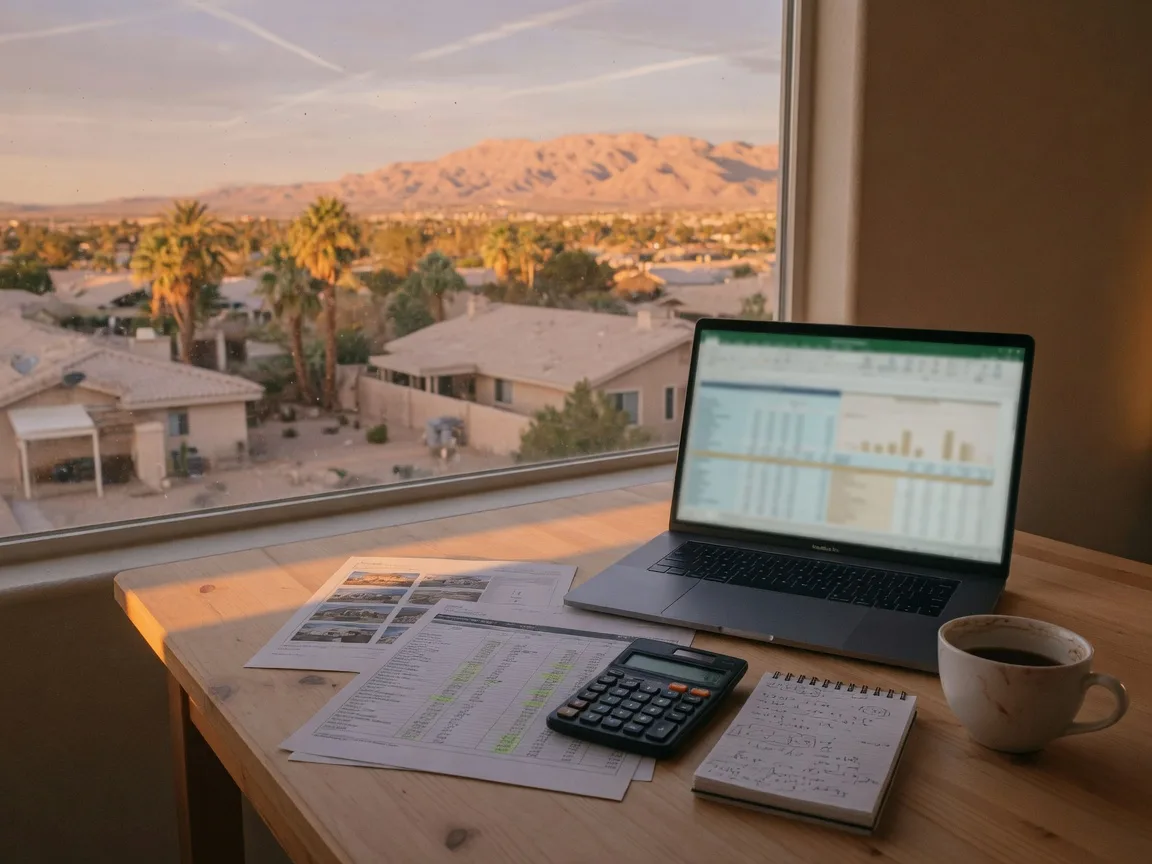
YOU DO NOT NEED TO KNOW EVERYTHING BEFORE YOU CALL LISA
This is especially important for the first-time investor.
You don't need to call and say:
I'm looking for a 6.25% cap rate with a 9% cash-on-cash return and a maximum 72% ARV acquisition basis.
If you know exactly what you're looking for:
Fantastic.
Give Lisa the buy box.
If you don't, you can call and say:
I have about this much available, I'm interested in buying an investment property, and I have no idea whether I should be looking at a rental or a flip.
That's a perfectly legitimate place to start.
Lisa can help with the real-estate side, show you the kinds of properties available and connect you with the appropriate professionals for financing or other specialized questions.
You don't need to become an investor before you're allowed to ask how investing works.
FOUND A PROPERTY YOU THINK MIGHT WORK?
This is where the entire investor system should come together.
You shouldn't have to stare at a Zillow listing and build the entire analysis from scratch.
Send Lisa the address.
Run Property DNA.
Look at comparable properties.
Estimate rent.
Choose the strategy.
Run the calculator.
Understand financing.
Inspect the property.
Estimate repairs.
Think through the exit.
Then ask:
DOES THIS PROPERTY STILL MAKE SENSE?
Maybe the answer is yes.
Maybe the numbers tell you:
Not this one.
That isn't failure.
One of the most valuable skills an investor develops is the ability to walk away from a property they really wanted to make work.
There will be another property.
Protecting your capital gives you the ability to buy it.
Final Call To Action
READY TO LOOK AT LAS VEGAS REAL ESTATE AS AN INVESTMENT?
Maybe this is your first property. Maybe it's your fifteenth. Maybe you're not sure whether you want a rental, a flip or something in between. Start with the property—or start with the plan.
INVEST WITH A PLAN, NOT A HUNCH.
Your Friend in the Industry.