
Quick Answer
Decorating for fall and the holidays in Las Vegas comes down to five habits: read the HOA rules first, choose low and anchored decor that survives wind, mount everything without damaging stucco, use tested outdoor lights on a GFCI-protected circuit with a timer, and keep candles and real trees away from anything that burns. Tasteful seasonal decor is a homeowner pleasure that also happens to help curb appeal; it does not require spending money on permanent upgrades.
October Is When the Valley Starts to Glow
By mid-October the pumpkin displays are up on front porches across Las Vegas, Henderson, and Summerlin. By Thanksgiving the rooflines get their first lights, and by December the whole valley is lit. Decorating for fall and the holidays is one of the few seasonal projects that is genuinely fun, works on any budget, and gives a home real personality. But the Mojave Desert sets its own rules for doing it well.
The average November afternoon in Las Vegas tops out near 67 degrees, and the average January low sits around 40, per National Weather Service normals. Wind gusts on stormy fall and winter days routinely reach 30 to 45 miles per hour, with high-wind events that can push past 60. Add intense sun that bakes plastic and cord insulation, stucco walls that punish nails, and an HOA that may regulate everything you put in view, and decorating here is a different craft than it is in milder climates.
This guide is for homeowners who want their Las Vegas home to look great from mid-October through New Year's, hold up to the desert, come down in January without leaving damage behind, and stay safe the whole time. It is a homeowner resource first. If a sale is somewhere on your horizon, there is a short section for you at the end, and it does not push you to spend money you do not need to spend.
Start With the HOA Rules, Not the Wish List
Read the rules before you buy a single pumpkin or string of lights. HOA rules across the valley vary a great deal, and seasonal decor is exactly the kind of thing they regulate.
Common provisions include: when seasonal decor may go up and when it must come down; whether inflatables are allowed and how long they may run; limits on the size, number, or brightness of light displays; whether items visible from the street must stay within certain months; and what kinds of stakes, mounts, or ground anchors are acceptable. Some communities also set quiet hours for displays with sound.
The fine for a violation is usually modest, but the fix-it letter in the middle of the holidays is not worth the hassle. If you rent, check the lease and talk to the landlord before you drill, mount, or stake anything. If your exterior is HOA-controlled, the HOA may own the very surface you want to hang lights on.
The Desert Decorating Calendar
Las Vegas runs three distinct decorating seasons, and each has its own practical notes.
Fall and Halloween: Now Through the End of October
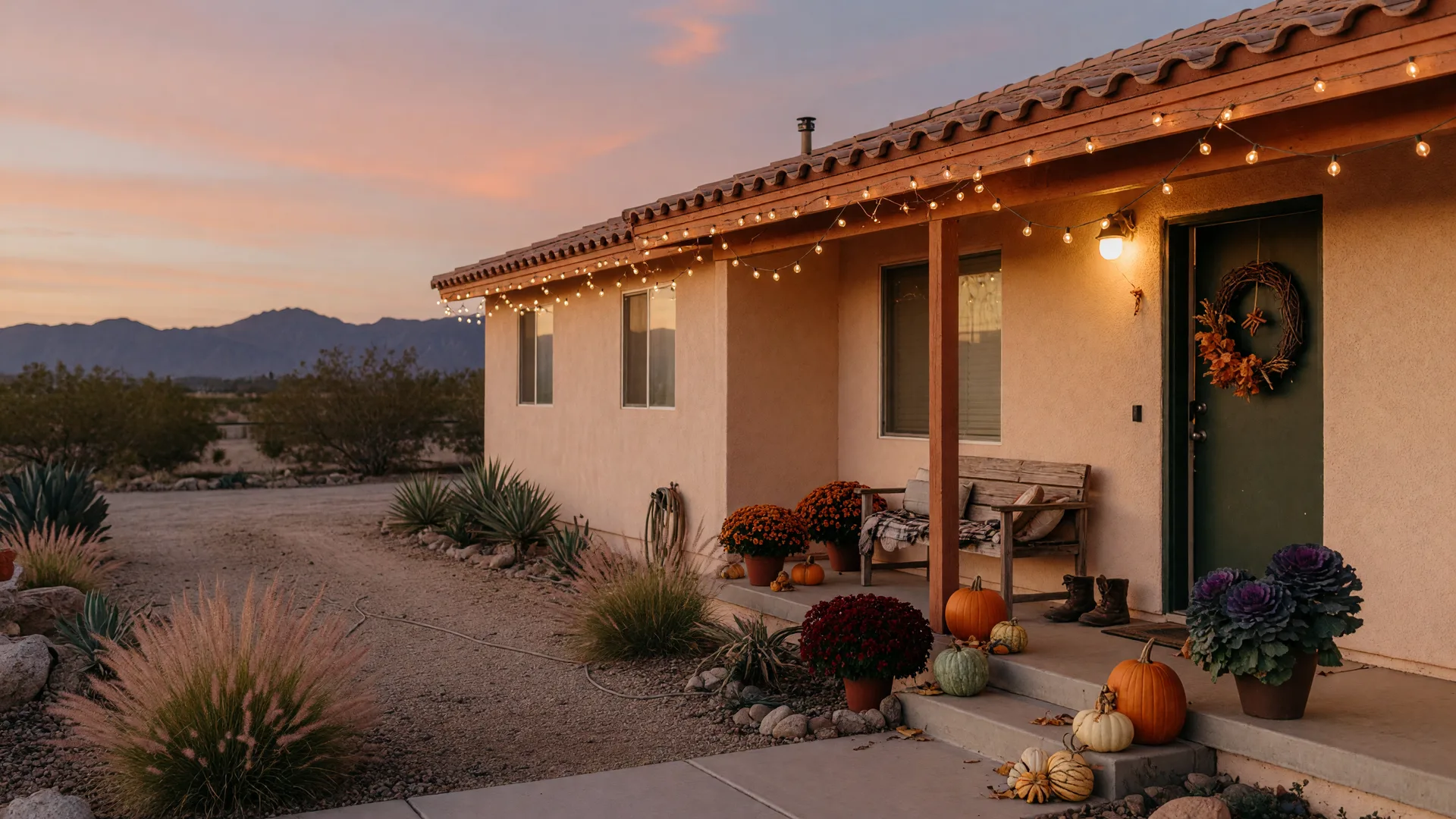
This is the porch and entry season. Mums, gourds, pumpkins, corn stalks, warm light, and a good wreath can make a stucco porch look intentional. The best fall displays are usually tidy: a strong arrangement on the porch or step rather than a sprawling scene across the whole yard.
Thanksgiving: November
The palette shifts from orange and black toward gold, rust, and deep green, and most of what you used in October can be reused with a few swapped accents. This is also the month when Las Vegas hosts start thinking about the inside: tablescapes, guest-ready bathrooms, and entryway staging that make a dinner party feel polished.
Winter Holidays: Late November Through Early January
Outdoor lights, wreaths, and the tree take center stage. This is where the safety section below matters most, and where the desert does its worst damage to cheap gear.
Why the Desert Is Hard on Decorations
Three forces in Southern Nevada shorten the life of decorations and change how you should buy them.
Wind is the first. Average wind speeds are modest, roughly 6 to 8 miles per hour, but stormy fall and winter days bring gusts of 30 to 45 miles per hour and occasional high-wind events over 60. A single windy afternoon will shred a cheap inflatable, topple a top-heavy display, and send lightweight decorations rolling across the block. Anything tall, light, or inflated needs anchoring, or it will not be there tomorrow morning.
Sun is the second. UV light fades plastic, cracks rubber, and embrittles cord insulation. A string of lights that spent a Las Vegas summer in a garage is not the same string it was in January. Inspect everything before you plug it in, and replace rather than patch anything cracked, frayed, or stiff.
Heat swings are the third. Decorations can bake in a warm afternoon and sit near freezing overnight. Thin plastic and cheap wiring are exactly what fails in that range.
What Actually Holds Up on a Las Vegas Porch
Here is an honest list of what works and what usually does not.
What works:
- Stone, ceramic, and heavy resin pumpkins and gourds. They do not rot, they do not blow over, and they look intentional.
- Low, wide arrangements on the porch or front step, where they catch less wind.
- Real pumpkins kept out of direct sun and swapped out as soon as they soften. A collapsing pumpkin in the desert becomes a sticky, fly-attracting mess fast.
- A wreath on the door mounted with a wreath hook that does not damage the frame.
- String lights mounted securely along rooflines and window frames, not draped loosely where the wind can tangle them.
- Small solar accents and lightweight yard stakes, anchored and weighted at the base.
What tends to fail:
- Large inflatables, unless properly anchored with the manufacturer's stakes or weighted bases, and unless the HOA allows them. They are also the item most likely to trigger a rule.
- Tall, top-heavy displays such as stacked hay bales with corn stalks, unless tied down.
- Exposed fans or blowers that run all night.
- Cheap plastic figures that bake, fade, and crack before the season is over.
Mounting Decor Without Damaging a Stucco House
This is the detail that separates a great display from a repair bill. Most Las Vegas homes are stucco over concrete block or wood frame, and stucco is not siding. Nails and screws driven into stucco leave holes that let moisture in, and patching stucco to match is not a five-minute job.
The safe approach is to use adhesive hooks and clips rated for the surface and weight, mount hardware into door and window frames or trim where trim exists, and use light clips designed for gutter and roofline mounting. Avoid driving hardware into stucco, EIFS, or synthetic stucco. If something heavy truly needs a wall mount, use the right anchor for the material and plan to have the hole sealed properly when the season ends. Never run a cord in a way that pinches it between a window and its frame, and never staple through a cord.
Most neighborhoods in the valley have a look that does this automatically: warm white lights along the roofline, a wreath, and a tidy porch. It is durable, inexpensive, and reads as polished from the street.
Holiday Lights: The Safety Basics That Matter
Holiday lighting is where the fun can turn into a house fire, and the statistics are real. The National Fire Protection Association reports that electrical distribution or lighting equipment was involved in about 2 out of 5 home Christmas tree fires. Most of that risk is avoidable with a handful of habits from the U.S. Consumer Product Safety Commission and the NFPA.
Buy tested lights. Use only lights tested by a nationally recognized testing laboratory, which in the United States means a UL, ETL, or ITSNA listing on the label. Use lights rated for outdoor use outdoors and indoor-rated lights inside.
Inspect every set before you plug it in. Check for cracked sockets, frayed or bare wire, and loose connections, and throw out any damaged set instead of patching it. This matters extra in Las Vegas, where strings bake in garages all summer.
Do not overload. A traditional incandescent mini-light strand is generally limited to about three strands connected end to end, per manufacturer guidance. LED strands draw far less current and more can usually be connected, but the limit printed on the package is there for a reason. Follow it.
Protect the circuit. Plug outdoor lights into a GFCI-protected circuit, and use extension cords rated for outdoor use that are not cut, cracked, or frayed. Run cords so they do not cross walkways where people trip, and keep them out of standing water.
Turn it off. Turn the lights off when you go to bed or leave the house. A timer makes this automatic and saves power at the same time. Never use electric lights on a metallic tree.
Climb safely. Ladder falls are a leading cause of holiday decorating injuries. Set the ladder on level ground, keep three points of contact, and never overreach. If the job involves the roof, the roofline, or anything beyond a step ladder, that is a job for someone with the right equipment.
Candles, Trees, and the Indoor Side
Candles are the other big holiday risk. The NFPA recommends keeping lit candles at least 12 inches from anything that can burn, in stable holders that cannot be knocked over, and never leaving them unattended. Blow them out before you leave the room, go to bed, or leave the house.
Battery-operated flameless candles give the same glow with no open flame, and in a house with kids or pets they are the practical choice for most spots. If you use real candles, keep them away from the tree, curtains, and mantle decor.
If you buy a real tree, keep it watered so it does not dry out, and keep it away from heat sources. A dry tree is the single worst fuel in the house.
The Desert-Friendly Palette
Southern Nevada has a natural advantage: the warm earth tones that look right here, terracotta, sand, sage, rust, and gold, are exactly the colors of a classic fall palette. You do not have to fight the landscape to look festive.
For pots and planters, the cool months are the best growing season in Las Vegas. Cool-season color such as pansies, cyclamen, ornamental kale, and snapdragons can carry a front porch from October through spring on a fraction of the water a summer annual needs. Pair them with pumpkins and gourds and you get a display that keeps looking fresh instead of dying in the heat.
Keep the walkway clear and lit. The same wind that moves decor drops leaves and debris onto the path, and a guest walking up a dark, cluttered entry in December is a fall waiting to happen. Light the path, keep the walk clear, and make sure the house number is visible from the street. A clear, lit, tidy entry is also, not coincidentally, the first thing a real estate buyer notices.
If a Sale Is Somewhere on Your Horizon
This is a homeowner guide first, but the timing deserves one honest note. If you are planning to sell in the coming months, tasteful seasonal decor is genuinely helpful. It makes the house feel cared for in listing photos and gives buyers a reason to pause at the front door. A warm, simple fall display photographs well and costs almost nothing.
What does not pay off is spending money on permanent changes you would not otherwise make just to sell. A full remodel, new kitchen counters, or a backyard overhaul rarely returns its cost in a quick sale, and no amount of seasonal decor hides a real problem from an inspector. Lisa's guide to preparing a Las Vegas home for sale covers what is actually worth doing, the article on repairs worth making before listing separates the money-makers from the wish list, and the piece on whether to renovate before selling keeps you honest about the big-ticket items.
If you are curious whether your house shows the way it should, you can request a free home value analysis from Lisa, get a free Property DNA report for any address, and read the Complete Las Vegas Seller's Guide when you are ready to think like a seller. Call or text 702-743-4608 anytime.
A Quick Decorating FAQ
When should I put up and take down holiday lights in Las Vegas?
The best answer is your HOA's. Many communities set specific dates, and it is far easier to follow them than to argue about them. When no rule exists, a practical Las Vegas schedule is fall decor up in early October, winter lights up after Thanksgiving, and everything down by the first weekend of January.
Are LED lights worth it in Las Vegas?
Yes, for three reasons. They draw far less current, which matters when you are running a long roofline display; they run cooler, which reduces fire risk; and they use less power, which matters when they run for two months.
Can I drill into stucco to hang decorations?
Avoid it. Stucco is not siding, and every nail hole is an entry point for moisture. Use adhesive hooks and clips rated for the surface, mount into frames and trim where it exists, and reserve wall mounting for heavier items with the right anchor and a plan to seal the hole.
How do I keep my decor from blowing away?
Anchoring and weight. Inflatable and tall displays need the stakes or weighted bases they shipped with, and anything top-heavy needs tying down. Low, wide arrangements on the porch catch less wind by nature.
What should I do with real pumpkins after the holidays?
Swap them out as soon as they soften, before they become a pest magnet. Compost them or set them out with your green waste if your hauler accepts it, rather than letting them rot in the sun.
