
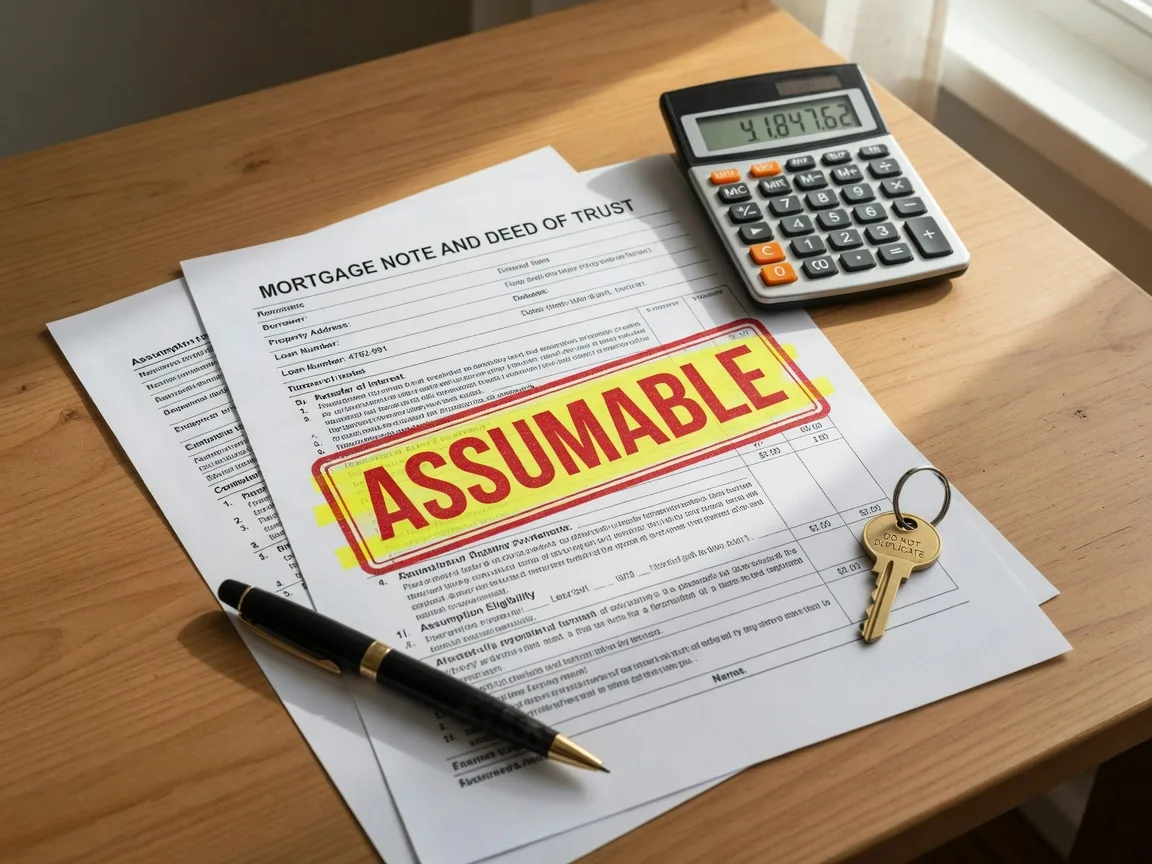
With mortgage rates hovering near recent highs, buyers are looking for every possible way to lower their monthly payment. One strategy that has gained attention is the assumable mortgage, a feature that allows a home buyer to take over the seller's existing loan instead of getting a new one at today's rates. The concept is simple. In practice, it involves important details every buyer and seller should understand.
What Is an Assumable Mortgage?
An assumable mortgage is a home loan that can be transferred from the seller to the buyer. When a buyer assumes the seller's mortgage, they take over the remaining balance at the seller's existing interest rate and terms. If the seller locked in a 3% or 4% rate during a previous period of low rates, the buyer could inherit that rate instead of borrowing at current market rates that may be significantly higher.
Not all mortgages are assumable. Conventional loans sold to Fannie Mae or Freddie Mac generally are not assumable. However, government-backed loans including FHA loans, VA loans, and USDA loans typically include assumability provisions, though each has specific qualifying requirements.
Why Assumable Mortgages Are a Big Deal Right Now
The gap between rates on existing mortgages and current market rates is significant. A seller who financed their home at 3.5% five years ago holds a loan that is substantially below today's mortgage rates. For a buyer who assumes that loan, the monthly payment savings can run hundreds of dollars per month compared to taking out a new mortgage at current rates. Over the life of a 30-year loan, the total savings can reach tens of thousands of dollars.
The Equity Gap Complicates Things
Here is where assumable mortgages get tricky. The seller's existing loan balance is based on what they originally paid, not what the home is worth today. If the home has appreciated significantly, the difference between the sales price and the remaining loan balance can be substantial. That gap must be covered by the buyer's own funds or by a second mortgage.
For example, consider a home purchased five years ago for $350,000 with a 3.5% FHA loan. The remaining balance might be around $320,000. But the home is now worth $450,000. A buyer who assumes the $320,000 loan at 3.5% would still need to come up with $130,000 to cover the difference between the loan balance and the purchase price. That is a significant amount of cash or a second lien.
How an Assumable Mortgage Changes Negotiation
When a home qualifies for an assumable mortgage, it can become significantly more attractive to buyers. Sellers who advertise an assumable loan often attract more interest and may receive offers closer to their asking price. For a seller, offering an assumable mortgage can be a competitive advantage. For a buyer, it can mean a dramatically lower monthly payment.
How to Search for Assumable Mortgages
Finding homes with assumable mortgages requires a more targeted approach than a typical home search. Some real estate platforms allow you to filter for assumable listings. Your agent can also search MLS comments for sellers or agents who have flagged their loan as assumable. FHA assumable loans are among the most common, so asking your agent to look for recent FHA-financed properties can be a productive strategy.
VA Loans and Assumability
VA loans are assumable by both veterans and non-veterans. For VA loans originated before a certain date, the assumption may not require lender approval of the buyer's creditworthiness. For newer VA loans, the lender must approve the assumption, which means the buyer still needs to qualify financially. VA loan assumptions can be especially valuable because VA loans often offer favorable terms and do not require private mortgage insurance.
An Assumable Mortgage Is Not Always Better
An assumable mortgage is not automatically the right choice. If the seller's remaining balance is small relative to the purchase price, the gap the buyer must cover can be too large to make the deal work. The buyer must also meet the lender's qualification requirements for the assumption, which may include a credit check and income verification. And in some cases, the seller's remaining loan term is short enough that the monthly payment benefit is less significant than it appears.
When an assumable mortgage works, it can save buyers significant money. When it does not, it simply adds complexity. The key is understanding how assumable loans work, working with an agent who knows how to find them, and running the numbers carefully before committing.
