
Quick Answer
In Las Vegas, check your HVAC filter once a month and change a standard one-inch pleated filter every 30 to 90 days, leaning closer to 30 days during heavy cooling season and right after dusty storms. Change it at least every three months no matter how it looks, follow the manufacturer's label on your specific filter, and stick with MERV 8 to 13 for most systems unless an HVAC professional confirms your equipment can handle higher.
The Filter Question Almost Every Las Vegas Homeowner Asks
"How often should I change my HVAC filter?" is one of the first maintenance questions every homeowner asks, and in Las Vegas the honest answer depends more on the desert than on the calendar. The short version: check the filter once a month, and change a standard one-inch pleated filter every 30 to 90 days, leaning closer to 30 days during heavy air-conditioning season and right after dusty storms. Change it at least every three months no matter how clean it looks, and follow the manufacturer's label on the specific filter you buy.
This guide is a homeowner resource first. It protects the air you breathe, the electric bill you pay, and the equipment that keeps the house livable, all for the price of a filter. It does not replace your manufacturer's instructions or a licensed HVAC professional, and where a spec matters, the label on the filter and the manual on the system win every argument.
Why Las Vegas Is Harder on Filters Than Most Places
The national advice about filters assumes an average home in an average climate. Las Vegas is not that home, and three local facts push every interval toward the shorter end.
The air is dusty. Wind events and dry conditions carry desert silt that lands on everything outdoors and makes its way indoors through doors, windows, and the fresh-air path of the system. After a dust storm, a filter can look months old in a weekend.
The AC runs a lot. A Las Vegas cooling season stretches from spring well into fall, so conditioned air passes through the filter far more months, and more hours per day, than in milder markets. More run time means more air through the filter, which means more captured dust.
The valley builds constantly. Construction, road work, and grading kick up fine dust that drifts for blocks. A home near active construction loads its filter faster than the same home in a finished neighborhood.
Add pets, allergy season, and an occasional wildfire-smoke event, and the case for checking the filter monthly stops being a suggestion.
How Often to Change It: The Straight Answer
The federal ENERGY STAR program, which tracks the efficiency of home heating and cooling, gives the guidance most technicians repeat: check the filter every month, especially during heavy-use months like winter and summer; if it looks dirty after a month, change it; at a minimum, change it every three months. The EPA's air-cleaner guidance makes the same point in different words: replace the filter when it looks dirty, on an interval that fits your filter type, your home, and how much the system runs.
Manufacturer intervals follow the thickness of the filter media:
- One-inch pleated filters: every 30 to 90 days. A typical home without pets can run about 90 days; a home with pets, allergies, or heavy use runs 30 to 45 days. Most Las Vegas homes, with the AC running hard, land between 30 and 60.
- Four-inch media filters: roughly every 3 to 6 months, per common manufacturer guidance.
- Five-inch media filters: roughly every 6 to 12 months, per common manufacturer guidance.
The label on the filter box is the final word for that specific product, and the age and condition of your equipment matters too. An older system with a struggling blower appreciates a filter changed on the shorter end of its range.
Where the Filter Lives, and How to Buy the Right One
New Las Vegas homeowners sometimes discover the filter slot by accident, which is why the first task is finding it. There are two common setups.
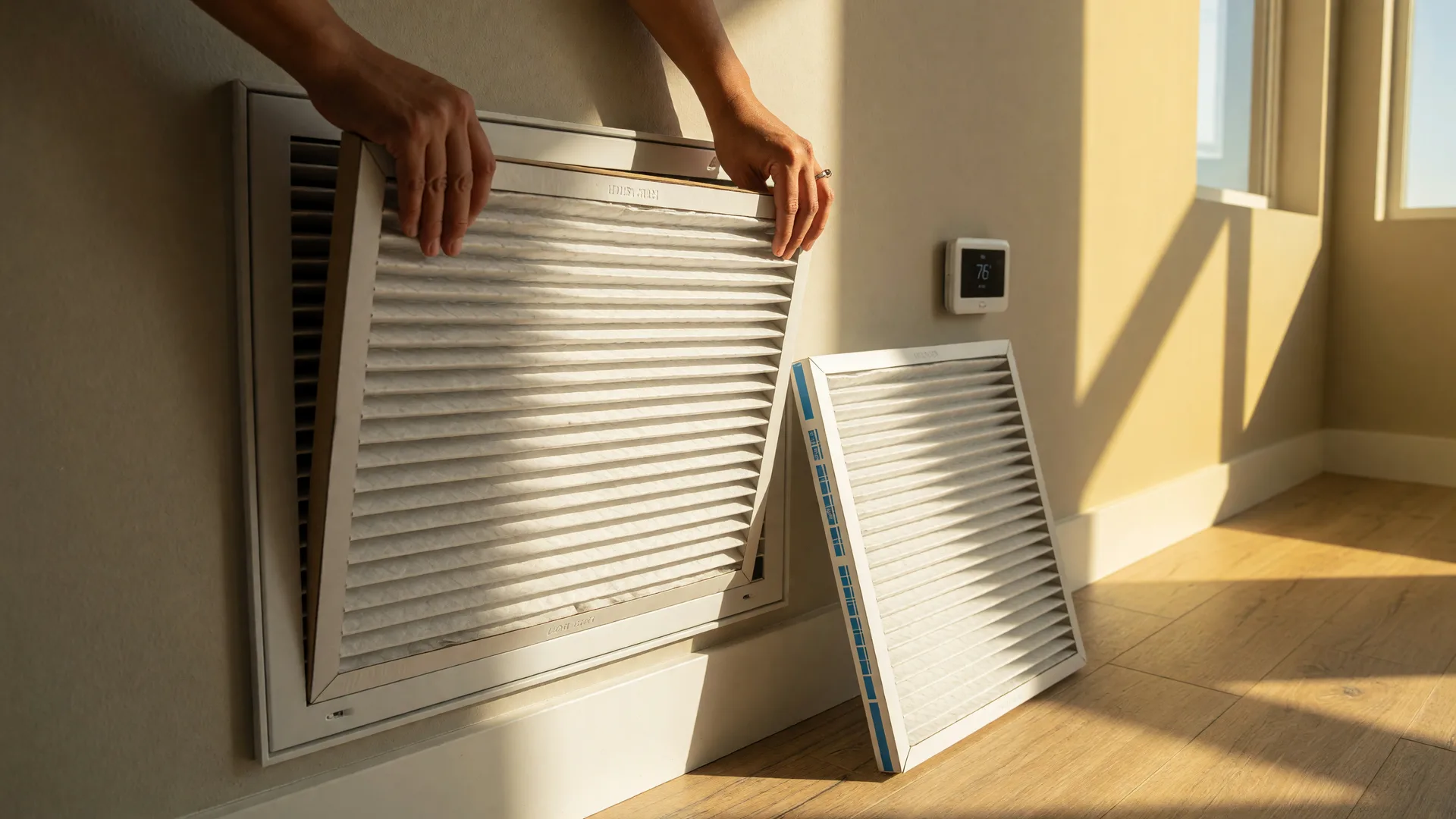
Return-air grille: a wall or ceiling grate, usually in a hallway or on the ceiling, that pulls air back to the system. Many grilles swing open and hold the filter directly inside. The filter is the size printed on its cardboard frame, like 20 by 20 by 1.
Filter cabinet at the unit: a slot at the furnace or air handler, often in the garage or a utility closet, that takes a filter inline with the duct.
Buy the exact size printed on the frame. A filter that is too small lets air slip around the edges and defeat the whole point; a filter jammed in too tightly can bow and tear. The arrows printed on the frame point in the direction of airflow, toward the furnace or air handler, and the filter installs with the arrow pointing the way the air moves.
MERV: What the Rating Means, and When Higher Is Wiser
Filters carry a MERV rating, which stands for Minimum Efficiency Reporting Value. It comes from a standardized ASHRAE test method, so you can compare one brand with another, and it describes the worst-case performance the filter will deliver at capturing particles in a specific size range.
Higher MERV numbers capture more, and smaller, particles: standard dust and pollen at the lower end, mold spores and finer dust in the middle, and at MERV 13 and up, a meaningful share of smoke particles and other very fine material. The EPA's Guide to Air Cleaners in the Home says that if you upgrade the filter in your furnace or central system, choose at least MERV 13, or the highest rating your system's fan and filter slot can accommodate.
The catch is airflow. A higher-MERV filter traps more, but it also resists more, and a blower can only push so hard. On a system designed for a modest filter, a very high-MERV filter can slow airflow enough to raise energy use, strain the equipment, and reduce comfort. The EPA is explicit that the duct system should be designed so the filter's pressure drop fits within the system's limits, and that the filter should fit and seal properly so air cannot bypass it.
For most Las Vegas homes, a pleated MERV 8 to 13 filter is the practical sweet spot: real filtration without gambling on airflow you cannot measure. If you want MERV 13 or higher, the safe move is a quick conversation with the HVAC contractor who services the system, especially on an older unit. They can confirm the fan and ductwork can handle it.
What a Dirty Filter Actually Costs You
A filter is the cheapest part of the HVAC system, and skipping it is one of the more expensive ways to save money:
- Higher energy bills. A clogged filter slows airflow, so the system runs longer to move the same heat, and every extra minute is meter time.
- Strain on the equipment. The blower works harder against a blocked filter, and the heat exchanger and coil run hotter and colder than designed. Technicians see summers where an iced-over evaporator coil traces back to a filter nobody changed.
- Less comfortable, unhealthier air. A loaded filter lets air push around it and carry dust through the house, which is the opposite of what the filter is for. For allergy and asthma sufferers, the difference is felt within days.
- Shorter equipment life. The expensive failures, compressor and furnace failures, are the ones a $15 filter change is designed to help prevent.
The seasonal article on fall home maintenance treats the filter as the cheapest high-value task on the whole fall checklist for the same reason.
When to Change It Early
The calendar is a floor, not a ceiling. Change the filter early when:
- A wind or dust storm coated the neighborhood. Check the filter that day; a filter that looks loaded is loaded.
- Construction, grading, or road work is active near the home.
- The system has run nearly nonstop through a heat wave.
- Pets that shed live indoors, especially when anyone in the house has allergies.
- You finish a remodel. Drywall, sanding, and paint dust are brutal on filters and on indoor air.
- Smoke from regional wildfires drifts into the valley.
The guide for new Las Vegas residents to summer makes the same point from the June side of the year: in this climate the filter is a monthly habit, not an annual chore.
The Real-Estate Connection: A Filter Habit Is a Cheap Signal
This is a homeowner guide first, but the real-estate overlap is worth one honest paragraph. If a sale is anywhere on your horizon, a fresh filter is the cheapest visible proof that a home was cared for, and the habit behind it shows up in the maintenance records buyers and their agents appreciate. It will never be the reason a home sells, and no buyer pays more because the filter is new, but it costs ten minutes and a few dollars, and it quietly removes one more excuse for an inspector, an alert buyer, or a lowball offer to find fault.
What does not pay off is turning the filter habit into a spending spree. A new filter and a tidy service record are the right scale; a full HVAC replacement to impress a buyer is a conversation to have with Lisa before you spend the money. Her guide to preparing a Las Vegas home for sale, the breakdown of repairs worth making before listing, and the reality check on renovating before you sell are the right reading there, and a free home value analysis tells you what the house is worth before you decide what is worth doing to it. Pair any address with a free Property DNA report and you know the ownership and value story before you invest a dollar.
A Filter Routine You Can Keep
The goal is a habit you cannot forget, not a heroic annual cleanup:
- Set a recurring monthly reminder on your calendar, on the first of the month, or in whatever app you actually check.
- Buy a multi-pack so a new filter is always in the garage when the old one is done.
- Write the install date on the filter frame with a marker so "when did I last change this?" answers itself.
- Check more often in peak cooling season and after dust events, about as often as you think about the thermostat.
Two minutes a month beats a service call in July.
Questions Homeowners Ask Most
How often should I really change a 1-inch HVAC filter?
Every 30 to 90 days for a standard one-inch pleated filter, with the shorter end for pets, allergies, heavy use, and dusty conditions. The federal ENERGY STAR guidance is to check monthly and change at least every three months, with more frequent changes when it looks dirty.
Is a higher MERV filter always better?
No. Higher MERV captures more and smaller particles, which is why the EPA recommends at least MERV 13 when upgrading, but it also restricts airflow and can strain a system that was not designed for it. Most Las Vegas homes do well at MERV 8 to 13; confirm anything higher with an HVAC professional.
What happens if I never change the air filter?
Airflow slows, the system runs longer and works harder, energy bills rise, dust gets pushed around the filter and through the house, and the equipment is more likely to fail early. A clogged filter is frequently the real cause behind an iced coil in summer or an overheating furnace in winter.
The filter looks clean after a month. Do I have to change it?
You do not have to rush the change at the 30-day mark if it is genuinely clean, but check monthly and change it at least every three months regardless. The three-month ceiling keeps the habit honest, and in a dusty climate a filter that is really clean after a month of use may be a sign the system has not been running.
Sources and Data Notes
- Filter change guidance: ENERGY STAR, Heat & Cool Efficiently: check the filter every month during heavy-use months, and change it at least every three months.
- Indoor air and filtration guidance: EPA, Guide to Air Cleaners in the Home and EPA, What is a MERV rating?.
- Replacement intervals of 30 to 90 days for one-inch pleated media and several months for thicker media reflect common manufacturer guidance; the label on your specific filter and the manual for your system take precedence.
This article is educational and is not HVAC, medical, or real-estate advice. When in doubt about a specific system, a licensed HVAC professional who can measure airflow and static pressure is the right call.
The Bottom Line
In Las Vegas, the filter is monthly maintenance with a three-month hard ceiling, MERV 8 to 13 for most homes, and an early change after every dust event. It protects the air, the bill, and the equipment, and it takes about as long as checking your mail. The desert gives you every excuse to be a little more careful.
Need a hand deciding what maintenance is worth doing, or what your home is worth as it sits? Lisa C Hamilton is a Las Vegas Valley REALTOR who can help you tell the difference between a $15 filter and a $15,000 project. Contact Lisa or call or text 702-743-4608.
